
Pay heed to the "Nanny Stern" of the fashion world!
There are loads more such gems over at Glamourdaze...
Pay heed to the "Nanny Stern" of the fashion world!
There are loads more such gems over at Glamourdaze...

From The Evening Standard:
Visitors to the exhibition may feel wistful contemplating a period when science was allied with the decorative arts, and it was for general consumption, not the preserve of specialists. Looking at the very beautiful scientific instruments and the marvellously accurate and captivating depictions of plants and animals, you’re reminded that science doesn’t have to be bleakly functional, but we have made it so.
And so it was that Hils, Crog, Madam Arcati and I, enticed by the prospect, trolled off last Sunday to the Science Museum ("middle sister" in the triumvirate of magnificent museums in South Kensington, between the Natural History and Victoria and Albert (V&A)) to see for ourselves...
We were not disappointed!
Excellently curated, the exhibition took us on an appropriately educational journey through The Age of Enlightenment, Bourbon royalty-style, starting with a focus on the three imperial monarchs who presided over this era - Louis XIV, XV and XIV - and the (rival, perhaps?) veneration of the intellectual icon of the time, Voltaire.

In the Salon of Madame Geoffrin in 1755. Reading of Voltaire's tragedy The Orphan of China in the salon of Marie Thérèse Rodet Geoffrin, by Anicet Charles Gabriel Lemonnier.
Louis XIV, not necessarily remembered as particularly "enlightened", nevertheless oversaw the founding of a Royal Academy of Sciences - and it was the assembled thinkers it attracted who enabled him to construct the ultimate vanity project, the Palace of Versailles. Its gardens alone were an engineering project on a scale unprecedented in the 17th century - the instruments that were used to create the symmetry of the layout, its aspect and the perspective that allowed trompes-l'œil galore to be employed for the titillation of the royal court were all on show, as were maps and illustrations of the mighty water-pumping system ("the Marly Machine") that enabled this isolated glittering folly to be supplied with more water than the whole of Paris at the time. Just to power the fountains! [That the King's minions had to artfully keep switching on and off as the royal party passed by, because the pressure was unsustainable.]


Science flourished at Versailles in a dizzying variety of ways: meticulous study of astronomy - even royal princesses were designing their own telescopes - and of the moon aided the accurate calculation of longitude (essential for a global empire), botanical advancements such as hot-houses permitted exotic foods to be grown (like the pineapple) to feed the aristocrats [less so the populace, bien sûr] and for potential medicinal plants to be studied, developments in chemistry (including Jean-Antoine Nollet’s ornate vacuum device) led to breakthroughs such as Lavoisier's treatise on the existence of oxygen, the refinement of microscopes and subsequent microbiolological breakthroughs led to a "craze" for inoculation against smallpox, anatomical study led to a greater understanding of the physiology of animals and humans (which assisted the progression of surgery; the excruciating five-hour operation to repair an anal fistula - without anaesthetic - that was performed on Louis XIV merited whole display of its own!), and the science of cartography [Oh! The globes that were on show were magnificent!] meant the the Cassini Map of France (also on show) was the most accurate ever. [It was in fact so accurate that it reduced the previously-drawn outlines of the French coast and Louis XIV lamented that it "cost me more territory than all my enemies!"]


From mapping continents and weather patterns for the benefits of imperial trade, and experimental designs for coastal defences to... obstetrics! Whoever would have imagined that in the mid-1700s, a midwife (Madame Du Coudray) would have sewn and stitched a model of a womb and foetus as a teaching aid for the safe delivery of babies?!
Or, for that matter, that taxidermy might have been so advanced that Louis XVI's Indian rhinoceros (from his menagerie) could be preserved with scarily accurate detail that has lasted to this day?
Of course, all this illuminating demonstration of human intelligence, inquisitiveness and ingenuity came with an equally impressive level of exquisite ornamentation. The two absolute stunners of the entire exhibition both happened to be timepieces - of significantly different scale and drama! There was of course that watch - designed for Marie Antoinette, and described rather well by historian Mathew Lyons:
...[it was] commissioned for Marie-Antoinette in 1783 from Abraham-Louis Breguet, who was given an unlimited budget. It has 823 parts, many of them in gold or sapphire. With no apparent financial or time constraints, Breguet kept adding new features, new complications, as he developed them. His work might have been a synecdoche for the court’s indifference to anything that lay outside its world view. How long did it take him to create something that articulated so meticulously the exquisite order and perfection through which the kings of Versailles sought to understand reality? Too long. Marie-Antoinette’s hand would never hold it. Breguet’s work was interrupted by the French Revolution and it would be 40 years before his watch was ready for delivery to a long-dead queen of a long-dead court...
...and then there was the massive and breathtaking Clock of the Creation of the World (designed by Claude-Siméon Passemant), possibly the most extravagant and opulent example of mechanical and artistic technique, with its multitude of functions including the massive golden sun picking out midday on a rotating terrestrial globe with its rays, rising opulently from silver and bronze waves. I was utterly awestruck...


I never thought that I would see such a collection of the treasures of the most decadent royal court in European history in the unassuming iron-girdered, solidly-built, somewhat austere environs of the Science Museum.
But I am so glad I/we did!
Versailles: Science and Splendour is only on until Monday 21st April, so you'd better be quick!
[click any image to embiggen]

...and this one is just wonderful! - as Richard Metzger of the fabulously bizarre Dangerous Minds [informing its regular readers - of which I am one - of a forthcoming new direction for the site] tells it like it is:
The glory days of the internet are long over. It had a good run, but it’s done.
I’d compare this sorry state of affairs to the history of widespread cocaine use in America, it’s almost the exact same story. (Okay, okay, it’s not even a remotely similar narrative, but don’t harsh my analogy!) At first, it was all fun and games. Pure and undiluted nose candy for the masses. The 1970s must’ve been incredible! But then the Devil’s dandruff starts getting stepped on. Unscrupulous dealers began cutting their Peruvian marching powder with baby laxatives and veterinary dewormers. Ultimately it becomes more of a situation where the dealers were cutting their baby laxative with cocaine and not the other way around. Now it’s all just garbage.
And that what’s happened with Internet content, too. When everyone got online in the mid-90s, it was fun and wild and fascinating. New and novel experiences awaited. Fast forward to today and the World Wide Web is sadly akin to a selfie and meme-filled version of WALL-E’s junkyard planet or an ocean full of plastic bottles and other human-created detritus. A friend of mine once described what we did at Dangerous Minds as “panning for Internet gold” but I told him I thought it was more like spelunking in a dank cave, standing in a river of shit wearing hip-high waders and a gas mask.
Today’s internet is by and large a highly toxic HAZMAT site. Assholes are everywhere you turn. You can’t escape them. But on top of that, all the creativity has vanished. What started as a massive outpouring of cross-cultural communication, international information exchange and just plain HIGH WEIRDNESS has turned into a filtered, Facetuned selfie-infested septic tank of “LOOK AT ME” frivolity, knucklehead narcissism and abject idiocy. The rise of the TikTok “expert” dolling out their supposed wisdom in 45-second increments seems to me an especially pernicious development. These people are seldom experts on anything other than hashtags and yet they all apparently have an audience 10X that of CNN’s.
With the AI apocalypse rapidly encroaching upon us it’s about to get even worse. I knew it when I first saw that Star Wars if it had been directed by Wes Anderson video. “Hmmm, that’s kinda clever” immediately gave way to “Okay I get this and I can’t be bothered to even watch it to the end.” It was a watershed moment for me and when I realised THIS SHIT IS THE FUTURE......So we’re going to do something different. Something that’s not been filtered or Facetuned or to be found anywhere in this cultural wasteland full of regurgitated garbage. Something with actual experts who know what they’re talking about and can speak intelligently for longer than a minute. Something that will make you smarter.
Wow!
Read the whole thing at the Dangerous Minds site.

One of the 20th century’s most dominant and divisive figures, Karl Marx’s work shaped hundreds of millions of lives. Which makes it all the more surprising it began over a biscuit.More than two decades before beginning The Communist Manifesto, a young Marx was awakened to the philosophy underpinning it after receiving much less than half of a Lebkuchen.
While his sister Louise may have thought the act playful, academics argue this event to be Karl’s first encounter with the unfair division of resources that would become his life’s work.
The eight-year-old’s first publication, known to historians as Das Kookie, reads: “There is no natural explanation, no justification, for why I should get less biscuit than my sister.
“Louise claimed the halves of Lebkuchen were even, but I could clearly see she kept the bit with the bigger splodge of icing for herself. This is mankind in essence, but must it be this way?
“My mother, as a class enemy, told me that Louise does not embody the unnatural evils of modern man, that I should be happy with what I got and not be greedy. Which caused me to realise society must be restructured from the top-down.
“It is my mother who ‘owns’ the biscuits. She stifles the supply. This biscuit was given to us when we helped to sweep the floors. But it is not a gift. It is the just reward of labour, and was only honey-spiced and not even chocolate.
“My sister is a mere cog in the machine of proletarian deprivation. As it is passed on to me, she nibbles a little off for herself. She claims she didn’t, but I saw her, and my bit of cookie is damp, so I licked her forehead and now I’ve been sent to my room. A political prisoner.
“I tried to tell Louise the system forces our conflict. We are Hansel and Gretel, kept at arm’s length from whole houses of cookies, and must seize the means of production. But she says she won’t be my friend unless I play dollies. The cycle of injustice continues.”
And so Marx realised the world was unfair, set out to right it and formulated philosophies of economics which are conservatively estimated to have killed millions – all because of a biscuit.
Next week: to 1960, when Che Guevara produced 100 T-shirts with his face on to advertise his car-washing business.
Of course

I found this quite fun - who knew how catty all these great composers could be about each other?
Composers in the collage:
First row - Antonio Vivaldi, Johann Sebastian Bach, Georg Friedrich Händel, Wolfgang Amadeus Mozart, Ludwig van Beethoven;
Second row - Gioachino Rossini, Felix Mendelssohn, Frédéric Chopin, Richard Wagner, Giuseppe Verdi;
Third row - Johann Strauss II, Johannes Brahms, Georges Bizet, Pyotr Ilyich Tchaikovsky, Antonín Dvořák;
Fourth row - Edvard Grieg, Edward Elgar, Sergei Rachmaninoff, George Gershwin, Aram Khachaturian

Missing your local bar during lockdown? Here are five ways to recreate the uniquely unpleasant atmosphere of your beloved watering hole at home.Paint the ceiling a horrible yellow colour
Despite the fact that no one has been allowed to smoke in them for years, many pub ceilings still bear the nicotine stains of several decades of happy smokers. Recreate this at home by dissolving several chicken Oxo cubes in a tin of white emulsion and slapping it on.Make the carpet sticky
The sticky trudge across the carpet for another pint is an integral part of the British pub experience. If you have young children, your floor coverings are likely heading towards total adhesion already. Allow them to make their own peanut butter and jam sandwiches for optimum stickiness.Create a naggingly unpleasant smell
Struggling to remember the aroma of your favourite local? It smells of old, lingering farts, like all pubs have since the smoking ban. To recreate this at home, have a pot of cabbage on a continuous rolling boil whilst occasionally wafting a jar of pickled eggs around.Never clean your toilet
No pub experience is complete without an unpleasant trip to the toilet. Make your bathroom into a nasty hell hole by pissing copiously all over the floor and scrawling obscene graffiti on the walls, then add one small urinal cake to the loo in a very token effort at hygiene.Become a pub bore
Every pub has some tedious old duffer perpetually sat at the end of the bar who loves droning on about things like Brexit and potholes. As the pub’s sole customer, this is your role now. Luckily you are also the landlord, so you can kick yourself out when you get too pissed and start shouting about immigrants.
Of course.
Pubs? I vaguely remember them...

Today (scarily) marks thirty years since the reunification of Germany, following the total collapse of the Soviet Eastern Bloc. Understandably, celebrations have been somewhat hampered by what maybe we should call today "the Trump virus", but nevertheless a significant milestone.
Never one to miss an opportunity, I thought I would focus, by way of celebration, on some of the - ahem - choicer musical gems I have featured over the years that originated in the Land of the Franks...
First up, perhaps our favourite Kraut-rocker, the utterly bizarre (and wonderful) Punk-turned-Big-Band-chanteuse Nina Hagen!
Here's a true classic from the late, sadly-missed Falco:
Another fave, the splendid Max Raabe (who we managed to get to see live in March this year, just weeks before lockdown), with his "tribute" to Britney...
The amazing, the unique, the irreplaceable, late, great Klaus Nomi:
And finally - possibly the weirdest clip in German cinematic history from the legendary Marika Rökk...
Gern geschehen.
Happy German Unity Day!


The UCL Petrie Museum has one of the largest and best-documented collections of Roman artefacts in the UK, including musical instruments that are too fragile to be played today.And we even got to play some of them! - who knew that a donkey's jawbone was used as a rhythmic percussion instrument in Roman times?
For this exhibition, researchers used laser scanning and computer modelling to create 3D printed replicas of the original objects in the Petrie collection, and made recordings of the instruments to reveal sounds not heard for hundreds of years.

So stop doing it. Stop it now!He was young and handsome, his mother’s pride and joy - but he died in torment, blind, sick and paralysed - at the age of seventeen. If only he’d known the perils of masturbation, then he might have lived a better life.This, in a nutshell, was the warning to young French men as published in Le livre sans titre (“The Book With No Title”) in 1830. At that time, masturbation was considered by moralists and physicians as a malady which lead to early death.
In 1716, Dr. Balthazar Bekker published a pamphlet on this “heinous sin” of “self-pollution” entitled Onania, which cautioned the reader self-abuse would lead to:
Disturbances of the stomach and digestion, loss of appetite or ravenous hunger, vomiting, nausea, weakening of the organs of breathing, coughing, hoarseness, paralysis, weakening of the organ of generation to the point of impotence, lack of libido, back pain, disorders of the eye and ear, total diminution of bodily powers, paleness, thinness, pimples on the face, decline of intellectual powers, loss of memory, attacks of rage, madness, idiocy, epilepsy, fever and finally suicide.Then in A Medicinal Dictionary of 1745, Dr. Robert James stated that onanism was responsible for “the most deplorable and generally incurable disorders.”
Another medical book L’Onanisme by physician Samuel-Auguste Tissot claimed semen was an essential body oil - which when wasted through masturbation caused:
....a perceptible reduction of strength, of memory and even of reason; blurred vision, all the nervous disorders, all types of gout and rheumatism, weakening of the organs of generation, blood in the urine, disturbance of the appetite, headaches and a great number of other disorders.These men weren’t quacks, either - they were highly eminent and respectable scientists working in the Age of Enlightenment. It is hardly surprising that these seemingly informed and scientific views should become so ubiquitous in the 19th century that they could end up as the cautionary tale of Le livre sans titre.


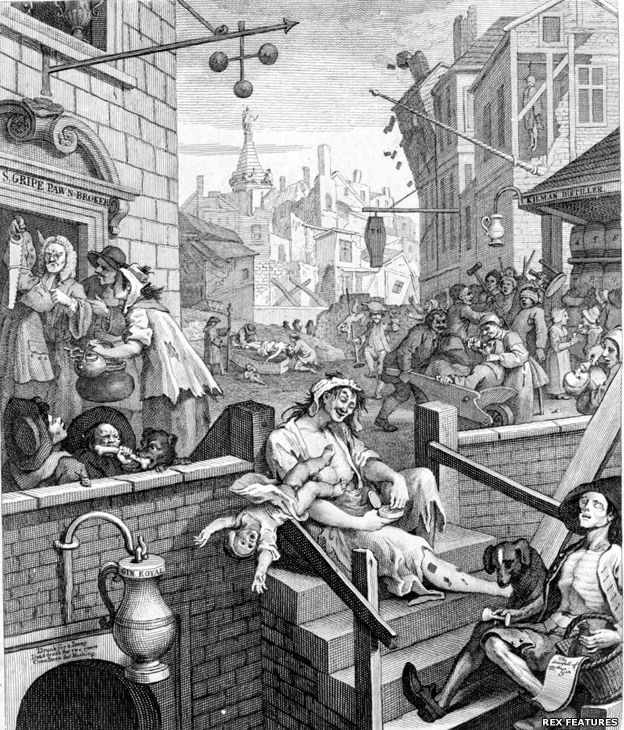
"As I delved into the archives I identified what I came to think of as England's oldest tradition of all – the tendency for people of a certain age to complain that the young people are out of control and that the country has gone to the dogs. Whenever I came across a sentiment like this, I would try to go back the 40 or 50 years or so, to the time when the chronicler of our national malaise had been young. But when I got back there, I found that people were saying exactly the same thing: English manners had disintegrated. The country had gone to the dogs... It's a complaint as old as England itself.England's Seven Sins on IMDB
"In 1860 the English press was in the grip of one of its periodic moral panics, brought on by a wave of juvenile delinquency. Gangs of youths, dressed in intimidating street-uniforms, were waging territorial street-battles and threatening respectable people. People were living in fear, and the streets weren't safe to walk on.
"The word "hooligan" was believed to have first emerged on the streets a couple of decades later and to have found its way into the newspapers in the late 1890s...
"But in an obscure manuscript, I found a much earlier appearance – as a resident of 1650's Turnmill Street (which is still there, on the edge of the City) complained of "gangs of hooligans who demand money with menaces from the poor washerwomen who wassh their clothes and do other thynges for theyre owne needs." (London: The Synfulle City – E.J. Burford, Robert Hale, 1990).
"As far back as the early 1600s, the streets of London were terrorised by a succession of organised gangs – with names like The Dead Boys, the Roaring Boys, The Bravadoes and the Mohocks. They amused themselves by breaking windows, demolishing taverns, assaulting Night Watchmen, rolling old ladies in barrels and slitting the noses of their victims with swords...
"And so it goes. Back through time. An endless succession of English ignorance and thuggery. The idea behind this film is not to imply that anti-social behaviour is not a problem – it is. It's turned our towns and cities into the vilest, ugliest, most barbaric places in the developed world.
"No, the real point is to put the current debate about anti-social behaviour into its historical context. Once we and Tony Blair realise that there never was a golden age of English decency, civility and manners, we can begin to have an intelligent debate about what to do".


