Showing posts with label Peter Tatchell. Show all posts

Saturday, 2 March 2024

Dizzying

It's another "snippets" post today, dear reader!

  • Sad news: We raise our glasses in tribute, as the world bids a fond farewell to eccentric centenarian style maven Iris Apfel, "Patron Saint" here at Dolores Delargo Towers, doyenne of magazine covers and fashion shoots across the globe at an age when most grannies are content to put their feet up and watch daytime telly, who has departed to preside over Fabulon. "I don't do minimal" was her watchword. Amen to that! [More Iris here, here, here, here and here]
  • "Woke gone mad" news: Children's classic Mary Poppins is the latest film to be subject to the seemingly never-ending tide of revisionist editing of history, as the British Board of film classification has increased its rating from "U" (unclassified) to "PG" (parental guidance needed), due to that fact that it uses the word "Hottenot" to describe South African native tribesmen. WTF?!
  • Rimming on TV news: Queer As Folk - the original UK Channel 4 series, not the tacky American remake that went on far, far too long - is celebrating 25 years since it shocked, and changed, the television-viewing world. Here's that rimming scene, for your delectation. You're welcome.
  • Dubious "gay allies" news: None other than millionaire thug Mike Tyson, after being challenged by the utterly fearless Peter Tatchell, has made a surprisingly positive statement about gay rights, saying: “I oppose all discrimination against gay people, OK?”.

  • And finally: Britain's favourite sexy gay pop-minx Olly Alexander has finally released the video (and full version) of his UK entry for the Eurovision Song Contest 2024! Verrrry Pet Shop Boys...

I would give you an update on today's weather, but it's shit, so I won't bother...

Wednesday, 7 June 2023

Sorry seems to be the hardest word

I'm re-posting this from the venerable Peter Tatchell, just because it is big news worth re-posting:

The Metropolitan Police Commissioner, Sir Mark Rowley, has said “sorry” to the LGBT+ community for his force’s past homophobic persecution. He’s the first UK police chief to apologise.

In a personal letter to human rights campaigner Peter Tatchell, which was read out in the House of Lords, at today’s launch of the #ApologiseNow campaign, Sir Mark wrote:

“The Met has had systems and processes in place which have led to bias and discrimination in the way we have policed London’s communities, and in the way we have treated our officers and staff, over many decades. Recent cases of appalling behaviour by some officers have revealed that there are still racists, misogynists, homophobes and transphobes in the organisation, and we have already doubled down on rooting out those who corrupt and abuse their position.”

Sir Mark concluded; “I am clear that there is much for us to do. I am sorry to all of the communities we have let down for the failings of the past and look forward to building a new Met for London, one all Londoners can be proud of and in which they can have confidence.”

LGBT+ rights campaigner Peter Tatchell, who led negotiations for the Met’s apology, said:

“We thank Sir Mark Rowley for being the first UK police chief to say sorry. His apology is a ground-breaking step forward that will, we hope, spur other police forces to follow suit. It draws a line under past Met persecution. This will help strengthen LGBT+ trust and confidence in the police; encouraging more LGBTs to report hate crime, domestic violence and sexual assault.”

The launch of the #ApologiseNow campaign, which is bidding to secure apologies from all UK Chief Constables, was hosted by Baroness Helena Kennedy KC and featured a video by the late TV star Paul O’Grady, recorded before his death. In it, Paul urged the police to say sorry for the often abusive, and sometimes illegal, way they treated LGBT+ people

Paul O’Grady backed the apology campaign based on his personal experience of police victimisation. He was present during a police raid on the gay bar, the Royal Vauxhall Tavern in London, on 24 January 1987. He described the raid as “homophobic…we were being treated like animals.”

The launch event heard testimony from LGBTs who were insulted and assaulted by the police. We heard from campaigner Alan Shea about homophobic police persecution on the Isle of Man, and the successful 2022 campaign to get the island’s Chief Constable to say sorry – the first police chief in the British Isles to do so.

Other police services across the UK are currently engaging with the #ApologiseNow campaign, but as discussions are at an early stage we will not be naming them.

“We are not asking the police to apologise for enforcing the law, but to apologise for the often illegal and abusive way they enforced it,” said Peter Tatchell, Director of the Peter Tatchell Foundation.

“Officers raided gay bars, clubs and even private birthday parties, insulting LGBTs as ‘poofs’ and ‘queers’. They gave the names and addresses of arrested gay men to local papers, which led to some being evicted, sacked and violently beaten. Police harassed LGBTs leaving gay venues and arrested same-sex couples for kissing, cuddling and holding hands, right up until the 1990s.

“The police did not make the law but they chose to enforce it in ways that today would be deemed illegal and unacceptable. They went out of their way to target gay and bisexual men to boost their arrest figures and ‘crime fighting’ reputation. Young handsome male officers were sent into public toilets and parks, where they lured gay men into committing offences and then arrested them. These so-called ‘pretty police’ acted as agents provocateurs.

“The yearly average of homosexual offences recorded by the police in England and Wales was nearly three times greater after the partial decriminalisation of male homosexuality in 1967, than it was in the previous eight decades of total criminalisation – clear evidence of a police witch-hunt.

“Police forces in New York, Copenhagen, Sydney, Berlin, Amsterdam, Montreal and San Francisco have apologised, as has the Chief Constable of the Isle of Man. UK police should do the same,”
said Mr Tatchell.

Paul O’Grady’s account of the police raid on the Royal Vauxhall Tavern on 24 January 1987:
“Police have apologised all around the world for their behaviour all those years ago. I think it is about time the British police did the same thing and said we are so sorry for what happened, because it was unnecessary. It was homophobic,” said Mr O’Grady

“I’d only been there for about ten minutes and a copper burst in the dressing room. I thought he was a stripper. He was so rude and so aggressive. And when I came out on the stage, they were all wearing rubber gloves. I said: ‘Oh good, have you come to do the washing up?’ There was pandemonium and people were scared.

“I was called a lascivious act in the South London Press and to tell you the truth I was delighted about that.

“Past injustices often cross my mind and this is one of them. The bloody cheek of them. It was disgusting, it was just offensive. We were being treated like animals. Pure homophobia that’s what it was. And nothing else will make me change my mind. So apologise, because I know where you are!”
said Mr O’Grady.

Peter Tatchell added: “In the 1980s, we had the Chief Constable of Greater Manchester, James Anderton, saying that gay people were ‘swirling round in a cesspit of their own making.’ He gave a green light for the police across the country to persecute our community.

“At the height of this persecution in 1989, there were 1,718 convictions and cautions for so-called ‘gross indecency’ between men – almost as many as in 1954-55 when male homosexuality was totally illegal, and the country was gripped by a McCarthyite-style anti-gay witch hunt.

“If the police say they have changed, they need to show it by acknowledging past wrongs. They need to follow the lead of the Met Police Commissioner. All Chief Constables should apologise for the many decades of past police harassment. Apologise now!”

The #ApologiseNow petition is now live at ApologiseNow.com

Tuesday, 25 January 2022

Furious Faggot


The incomparable and tireless champion of gay rights, civil rights and free speech, Patron Saint here at Dolores Delargo Towers, Mr Peter Tatchell is 70 years old today!

From his own Foundation's press release:

Peter Tatchell is one of Britain’s best known and longest surviving LGBT+ and human rights campaigners. He’s supported nearly every major human rights campaign for the last half a century – and taken on everyone from Mike Tyson to Tony Blair and the Archbishop of Canterbury.

He first began campaigning while still at school in 1967 aged 15, against the death penalty and the execution of Ronald Ryan in his home state of Victoria, Australia. He went on to champion indigenous Aboriginal rights and oppose Australia’s involvement in the Vietnam War. On moving to London in 1971, he was prominent in the newly-formed Gay Liberation Front and ... helped organise the UK’s first LGBT+ Pride parade in 1972 – this July being the 50th anniversary...

He stood as the Labour candidate in the notorious 1983 Bermondsey by-election – often regarded as the dirtiest, most violent and homophobic election in Britain since 1945. In 1990 he was a founding member of the LGBT+ campaign group OutRage! Its activism against homophobic discrimination included the most numerous and sustained direct action protests in Britain since the suffragettes.

Over the last five decades, he’s participated in 3,000 peaceful protests, been arrested 100 times and suffered 300 violent assaults by homophobes and far right extremists, including 50 attacks on his flat. He has described the violent assaults as like living through a low-level civil war. For many years he suffered from PTSD.

He was beaten unconscious by President Mugabe’s bodyguards when he tried to make a citizen’s arrest in Brussels in 2001 and suffered a severe beating by neo-Nazis in Moscow in 2007 when he supported the bid by Russian LGBTs to hold a Pride parade.

“My coordination, memory, balance, vision and concentration are somewhat impaired. Campaigning is more difficult but I still manage. I’ve no regrets. Compared to the jailing and torturing of human rights defenders in China, Russia, Syria and Uganda, I’ve got off lightly,” said Mr Tatchell.

All hail!

We would really love to see the recent film of the great man's life - co-produced (i.e. funded) by Sir Elton John and Peter Furnish, and featuring (among others) commentary and tributes from esteemed gayers such as Stephen Fry and Sir Ian "Serena" McKellen - Hating Peter Tatchell, but unfortunately it seems to have been snapped up by that behemoth Netflix, a service to which we stalwart BBC-ers would never subscribe, so I doubt we will get the opportunity for a while...

Regardless, we charge our glasses to a true hero!

Peter Gary Tatchell (born 25th January 1952)

Today also happens to be Burns' Night - yet another excuse for Scots to get pissed on whisky and eat pig guts - so what better way to pay tribute to Mr Tatchell's milestone birthday than with one of Scotland's finest bands and an appropriate choon?


OCH, AYE!


click to embiggen

Sunday, 25 July 2021

What do we want?!

“When Peter Tatchell asked if DIVA would support the Reclaim Pride March and explained the concept, there was no hesitation. The idea of taking Pride back to its roots is one that we’re absolutely behind.” - Linda Riley of DIVA magazine and Lesbian Visibility Week.

And so it came to pass that a smattering of members of "our gang" - me, Madam Arcati, John-John, Baby Steve and Houseboy Alex from Essex, Mark, and the Madam's sister Carol and neice Jen all the way from Plymouth (and her friend from Brighton, too) - gathered at Parliament Square for what promised to be an event that took Gay Pride back to where it began, as a protest rather than merely a party.


click any photo to embiggen

Organised and led by our "Patron Saint of Pride", the admirable and unstoppable Peter Tatchell, Reclaim Pride was the first of its kind in the UK [there have been similar protests against the "commercialisation" of Pride events in the US], and its route was planned to follow in the footsteps of the very first Gay Pride march in London in 1972, from Parliament up Whitehall, Trafalgar Square, Regent Street and Oxford Street to Marble Arch for a "picnic" in Hyde Park. Unfortunately the scheduled 1pm start was delayed by an hour-and-a-half thanks to a competing anti-lockdown and anti-vaccine protest that was coming the other way and being dispersed across Westminster Bridge, so our legs were beginning to ache from standing around even before we actually started marching...

The usual mad assortment of participants were in evidence, as is the case with any such event - butch dykes, camp queens, families with kids, drag queens, veterans of Prides past as well as people who weren't even born when Section 28 was "a thing", the Socialist Workers' Party (of course), BLM supporters, Trans Rights campaigners, earnest student-types and eccentrics alike - but we amused ourselves, being in close proximity to possibly the dullest-voiced chant-caller in the history of protests, by changing the words a little, so "What do we want? Liberation! When do we want it? Now!" became "What do we want? Liberace! When do we want him? Now!" and so on...

We had a blast, even if we didn't do the whole distance. Bladders full after the long delays, we decided to exit the march just before it turned the corner into Oxford Street (around halfway, so not too shoddy an effort, methinks), and "took the Pride march on a new route" - to our mate Sally's pub off Carnaby Street!

The Shaston Arms has traditionally been the "headquarters" for our Pride Days, as it's where we gather on "Gay Xmas" for champagne-and-bacon-butties breakfast and change into our outfits ready to face our adoring public (and we will no doubt be doing so again on the rescheduled "official" Pride London day on 11th September), so it seemed appropriate. We were joined by "non-participants" in the march Hils and Crog, Steve and Sian, Russ and Joe and of course (once she'd finished her stock-take and paperwork) by Sal herself - and didn't leave till our taxi arrived at last orders!

A fabulous day, all round.

To conclude, a classic:

Sunday, 28 June 2020

Lest we forget


“We insist on gathering in plain sight every year because for 2,000 years we were told to be invisible. This is the 50th calendar year in which we’ve walked the walk in London. We who were there in 1971 and 1972 walk now on behalf of our contemporaries who are too unwell, locked-down or far away, to join us. Many have already gone to LGBT+ heaven. And we walk in honour of the young who are fighting in every country around the world. We think of LGBTs in Hong Kong, Poland, Chechnya, Brazil and Indonesia, who seek the dignities that ought not be denied to anyone.” - Andrew Lumsden, GLF founder member.
Veterans of the original Gay Liberation Front, led by our hero Peter Tatchell, marched the Gay Pride route to mark 50 years of gay rights marches in the UK yesterday. I only wish I had known about it in advance; I would have gone along to support them.

Peter Tatchell Foundation

Thursday, 6 July 2017

Unnatural offences


Gay Pride '85 - I was there!

From The Independent:
“It was a famous gay pub,” says [activist and writer] Andrew Lumsden. “It was a place that made money out of gay customers and had declared a policy that no one in drag would be served, probably at the request of local police.

“About 20 of us went in, many of us dressed in drag. The landlord told us to get out and we refused so he called the police. In the end the police carried us out.”
The group were charged with disorderly conduct.

To happily add salt to the wound, members of the group attended their date at the Magistrates' Court dressed in their finest gowns.

“The Radical Queens arrived in beautiful drag. The magistrate was quite put out. There was no pretence that they were women. They were in hats, and frocks. Indeed immensely hairy chests surrounded by frills and furbelows was one of the great sights of the movement. We wanted to show that we were free to dress as we liked.

If we want to be camp, we will. It was breaking down the stereotypes of what a man must be like."
It is fifty years since the partial decriminalisation of male homosexuality in England and Wales. It was a landmark ruling, but deeply flawed. Trust the saintly Peter Tatchell to provide an in-depth analysis of what was the reality after the passing of The Sexual Offences Act 1967:
...research reveals that an estimated 15,000-plus gay men were convicted in the decades that followed the 1967 liberalisation. Not only was homosexuality only partly decriminalised by the 1967 act, but the remaining anti-gay laws were policed more aggressively than before by a state that opposed gay acceptance and equality.

The 1967 legislation repealed the maximum penalty of life imprisonment for anal sex. But it still discriminated. The age of consent was set at 21 for sex between men, compared with 16 for sex between men and women; a decision that pandered to the homophobic notion that young men are seduced and corrupted by older men. The punishment for a man over 21 having non-anal sex with a man aged 16-21 was increased from two to five years.

Gay sex remained prosecutable unless it took place in strict privacy, which meant in a person’s own home, behind locked doors and windows, with the curtains drawn and with no other person present in any part of the house. It continued to be a crime if more than two men had sex together or if they were filmed or photographed having sex by another person. Seven men in Bolton were convicted of these offences and two were given suspended jail terms – in 1998.

The 1967 reform applied to only England and Wales, not being extended to Scotland until 1980 and to Northern Ireland until 1982. It did not include the armed forces or merchant navy, where sex between men remained a criminal offence. Gay military personnel and merchant seamen could still be jailed until 1994, for behaviour that was no longer a crime between gay civilians. Legislation authorising the sacking of seafarers for homosexual acts on UK merchant ships was repealed only last month.

Centuries-old anti-gay laws remained on the statute book long after 1967 as “unnatural offences”. The two main gay crimes continued to be anal sex, known in law as buggery; and gross indecency, which was any sexual contact between men including mere touching and kissing. There was also the offence of procuring – the inviting or facilitating of gay sex. The law against soliciting and importuning criminalised men chatting up men or loitering in public places with homosexual intent, even if no sexual act took place.

Men were convicted under this law, before and after 1967, for merely smiling and winking at other men in the street.

...There were police stake-outs in parks and toilets, sometimes using “pretty police” as bait to lure gay men to commit sex offences. Gay saunas were raided. “Disorderly house” charges were pressed against gay clubs that allowed same-sex couples to dance cheek to cheek. Gay and bisexual men, and some lesbians, continued to be arrested until the 1990s for public displays of affection, such as kissing and cuddling, under public order and breach of the peace laws.

In 1966, the year before partial decriminalisation, some 420 men were convicted of gross indecency. But by 1974, my research shows, the annual number of convictions had soared by more than 300% to 1,711 in that year...

...In the 1980s, the Conservative government’s “family values” campaign whipped up hysterical levels of homophobia, aided by the moral panic over HIV/Aids. At the 1987 Conservative party conference Margaret Thatcher used her keynote speech to attack the notion that people had a right to be gay.

Coinciding with this intolerant atmosphere was a massive rise in arrests of gay men for consenting behaviour. In Home Office archives I found that there were 1,718 convictions and cautions for gross indecency in 1989. The 2,022 recorded offences of gross indecency that year was almost as many as the 2,034 recorded in 1954, when male homosexuality was totally illegal.

Full reform did not happen until 46 years after 1967. The gross indecency law of 1885 had been used to convict the computer genius Alan Turing in 1952 and, before him, to jail the playwright Oscar Wilde in 1895. Together with the criminalisation of anal sex, it was finally repealed by the Sexual Offences Act 2003. As a result, for the first time in 470 years, England and Wales had a criminal code that did not penalise gay sexuality. In Northern Ireland, the ban on anal sex was not finally repealed until 2008. Scotland’s anti-gay laws were repealed in 2009 but, in the case of sodomy, did not take effect until 2013. It seems scarcely credible, but gay sex ceased to be a crime in the UK only four years ago.
Food for thought, indeed.

So, although we celebrate the significant progress that has been made since the Sexual Offences Act fifty years ago, it is worth recognising that what today is a huge, micro-managed, over-regulated "parade" through Central London - Gay Pride - should actually be a prominent acknowledgement of the battles for genuine equality [by the likes of Mr Lumsden and his chums, and generations of feisty and indefatigable campaigners and protesters who followed] that actually took almost 46 years to achieve.

And in our charts this week fifty years ago?

How appropriate - It's Queen Aretha!


R-E-S-P-E-C-T
Find out what it means to me!


Indeed.

Watch When gay acts were a crime, a vignette from the BBC.

Wednesday, 17 May 2017

Freedom cannot be denied


To mark this year's International Day Against Homophobia (and Transphobia and "Biphobia"), I thought I would share with you the ever-incisive thoughts of our Patron Saint of Human Rights, Mr Peter Tatchell:

Queer freedom is an unstoppable global trend


The last few years have witnessed an unnerving backlash against lesbian, gay, bisexual, transgender and intersex (LGBTI) people in nearly 20 countries, including Russia, Morocco, Uganda, Iraq, Brunei, Syria, Nigeria and The Gambia.

This escalating repression has included more vigorous enforcement of long-standing laws criminalising same-sex relations; resulting in highly publicised arrests in countries such as Tunisia, Cameroon, India, Egypt and Senegal.

Prohibitions on same-sex relations

Seventy-three countries still have a total prohibition on same-sex relations. Half of them are members of the Commonwealth. Their homophobic laws were imposed by Britain in the nineteenth century, during the era of colonialism, and retained after independence.

The penalties for homosexuality include 25 years jail in Trinidad and Tobago and 20 years plus flogging in Malaysia. Several Commonwealth countries stipulate life imprisonment: India, Sierra Leone, Tanzania, Pakistan, Uganda, Bangladesh and Guyana.

There have also been new laws enacted in some countries, most excessively in Nigeria, which has outlawed LGBTI organisations, fundraising and public advocacy – and even banned gay-focused HIV prevention and LGBT-themed books and movies.

Lesser repression involves restrictions on media coverage of LGBTI issues and on the foreign funding of LGBTI groups, as happens in Uganda.

In these backlash countries, LGBTI people are increasingly demonised and scapegoated by demagogic politicians and fundamentalist clerics as a cheap way to win popular support.

At the start of 2016, a spokesperson for Malawi’s opposition party, Ken Msonda, sought to bolster his profile and win bigoted votes: “Arresting them (LGBTIs) won’t address this problem because sooner or later they are being released on bail. The best way to deal with this problem is to kill them!”

Anglican churches in Nigeria and Uganda have contributed to the witch-hunting atmosphere; supporting draconian new anti-gay laws.

Distracting from economic failings and corruption

To the delight of many governments, having an “enemy within” has conveniently distracted public attention from economic failings and corruption.

Hate rhetoric is fuelling homophobic mob violence – sometimes perpetrated by right-wing death squads – especially in Honduras, Brazil, Mexico, Peru and El Salvador. Over 200 Honduran LGBTI activists have been assassinated since 2008.

A disproportionately high number of victims of anti-LGBTI violence are transgender people. The Trans Murder Monitoring project reports that over 1,300 trans and gender-diverse women and men were murdered in Latin America from 2008 to 2014.

In recent years, the Indian and Singaporean courts have upheld the criminalisation of same-sex relations, and Burundi and Chad have outlawed homosexuality for the first time in their history.

Islamic State in Syria is targeting LGBTIs for execution, mostly by throwing them off tall buildings. In neighbouring Iraq, Shia militias are also waging a terror campaign against LGBTI people.

Despite this bleak picture, in the overwhelming majority of the world’s 193 countries, the trend is towards ever greater LGBTI acceptance and equality.

Greater LGBTI legal protections

In recent years, we’ve seen the decriminalisation of gay sex in Belize, Palau, São Tomé and Príncipe, Northern Cyprus, Mozambique, Nauru and the Seychelles.

There are legal challenges to the ban on same-sex relations in Jamaica and Trinidad and Tobago.

A Ugandan court annulled the notorious Anti-Homosexuality Act, albeit on a technicality. The new Bill to replace it has never been legislated.

Vietnam lifted the ban on same-sex marriage in 2015, as a prelude to its expected eventual legalisation.

The Botswana courts have for the first time recognised the right of an LGBTI organisation to be registered and the Indian Supreme Court has upheld the rights of the trans community.

Helem, Lebanon’s LGBTI group, has operated for over a decade; hosting the first LGBTI centre in the Arab world. Taiwan has elected its first woman president, a supporter of same-sex marriage, in a country where marriage equality now has more than two-thirds public support.

The first openly lesbian cabinet Minister has taken office in South Africa, while two men who were prosecuted for being gay in Zambia were acquitted at their trial.

Both the United Nations Human Rights Council and the African Commission on Human and People’s Rights passed resolutions in 2014 calling on governments to protect their LGBTI communities against discrimination and hate crime.

What the global public thinks

Research by the Williams Institute has found rising global acceptance of same-sex relations, including in many developing countries:

“Latin American acceptance of homosexuality ranges from a high of 34% in Uruguay to a low of 2% in Ecuador. On legal recognition for marriages for same-sex couples, Uruguay has the highest level of support at 57% while Guatemala has the lowest level of support at 12%. In Africa, acceptance of homosexuality ranges from a high of 38% in South Africa to a low of 2% in Ghana.”

These figures of support are still too low but nonetheless a big improvement on a decade ago.

In this context of majority progress, backlash is a minority blip in the overall worldwide trajectory towards LGBTI equality. It is a reaction to the positive gains won by brave, determined LGBTI human rights defenders, many of whom risk their liberty and lives. If we were not winning there’d be no backlash. Backlash is a dreadful but backhanded compliment.

LGBTI freedom has been long delayed but it cannot be denied.
There is, of course, a shorter message to anyone who dares to decry, discriminate, agitate or threaten violence against us. As is traditional on this day, we leave it to Lily Allen (and the GayClic Collab Against Homophobia) to say it.

Fuck You!:


Resources:

Wednesday, 22 June 2016

News of the Gay (Pride edition)


In the continuing countdown to Pride in London on Saturday, post-Orlando, what a mixed bag of news the gay world is experiencing...

Admittedly, out of tragedy came one of the biggest ever demonstrations of international unity against homophobia - at least in the civilised world. The parts of it that are not dominated by religious bigotry or tyrant rulers, that is.

Even as the American Embassy in Jamaica flew a rainbow flag at half mast, their bigoted bastard attorney general Marlene Malahoo Forte called this humanitarian gesture "disrespectful" to that benighted island's continued anti-gay laws. Disgusting!

And speaking of disgusting, gay rights campaigners had to resort to wearing gigantic angel wings in order to hide the lunatic fascists of the Westboro Baptist "Church" - who were picketing the funerals of the murdered clubbers - from the mourners.

Russia's continued malign influence over its neighbours also continued, as puppet state Moldova proposed an anti-gay law similar to Putin's own - which has been met with vocal protests.

But closer to home, there's promising news in the last bit of the so-called United Kingdom not to have enacted gay equality legislation, as Northern Ireland's executive is being pressured to draw up a marriage equality bill. At last.

Barclays Bank - one of the main sponsors - has turned its logo into a rainbow flag and features Pride on its home page:


...and London is "going to town" in preparation for The Great Event. Even the traffic lights have "gone gay"!

It wasn't always such an universally recognised day, mind you, as I remember - and as Peter Tatchell recounts so eloquently in this video "potted history":


Roll on Saturday!

Gay Pride in London

Sunday, 8 November 2015

Let's talk about sex, baby


"Millions of young people enter adulthood sexually and emotionally illiterate. Many subsequently endure disordered relationships, ranging from unfulfilling to outright abusive. The result? Much unhappiness – and sometimes mental and physical ill-health. The lack of effective - and statutory - sex and relationship education (SRE) in schools is part of the problem. It is mostly vague and euphemistic, with too little detail and not enough explicitness to be of practical benefit. Much of it concentrates on the biological facts of reproduction, often concerning other species such as rabbits. Very little teaching is actually about sex - or relationships. And it starts too late; usually after young people have become sexually active and adopted bad habits such as unsafe sex."
The annual address by the admirable gay rights campaigner Peter Tatchell to the LGBT Humanists (the artist formerly known as GALHA) - which I and Paul attended on Friday - took a distinctly critical look at the lamentable state of the British education system, when it comes down to educating the nation's kids about sex.

Nothing new here, I suppose - I assume that just about everyone in our cross-generational audience entered the weird and wonderful world of sexual discovery at best misinformed, at worst wracked with guilt, and essentially unprepared for "that moment" when the cherry gets popped. Sex "education" as far as I recall consisted of the Ladybird book "Your Body", playground gossip, the underpants pages of the Littlewoods catalogue, confusing medical diagrams, tabloid outrage, porn, and a red-faced and downright embarrassing ten-minute chat with a parent...

Mr Tatchell's proposals - and you can read them in full on the Teach Secondary educators' resource website - are sensible (if likely to set the pig-dogs at the Daily Mail frothing at the mouth with outrage), including frank discussion about matters of consent and enjoyment, safer sex and alternatives to penetration, difference and diversity (including gay and bisexual experiences), and (most important of all) accurate information about the "how, what, when, where and why" of sex and relationships.

It was another lively and thought-provoking evening that generated plenty of debate (despite the session being somewhat shorter than usual as Peter had to travel cross-country for another engagement) - and yet again served to prove that it takes someone like Mr Tatchell to say the things that people (particularly our benighted and under-educated political leaders) need to hear.

More power to the man!

For more information about the Peter Tatchell Foundation’s human rights work, to receive email bulletins or to make a donation, visit www.PeterTatchellFoundation.org.

Saturday, 15 November 2014

All human beings everywhere


Paul, Jim and I proudly attended the annual "State of the Nation" (or in this case, "Nations") address by the formidable human rights and LGBT rights campaigner Peter Tatchell last night, on the subject Organised religion is the greatest global threat to human rights (another brilliant event hosted by the marvellous Gay & Lesbian Humanists (GALHA) at the Conway Hall).

Suffice to say, it was jaw-droppingly brilliant. No words of mine can do it justice. Thus I turn to Peter's own words to provide the gist of the almost two hour speech:
"Organised religion is the greatest global threat to human rights; especially to the human rights of women and gay people. It invariably promotes sexist and homophobic discrimination in law."

“The title of Organised Religion is a controversial claim, and you might say that free market capitalism is the greatest threat to human rights. It is debatable what is a greater threat, but I think it is organised religion that is the single greatest threat.”

"From the US and Russia to Uganda and Iran, religious fundamentalism is seeking to thwart equality and human rights. It is the cause of much sectarian violence, as we have seen in the Central African Republic, Nigeria, Pakistan, Burma, Somalia – and for many years in Northern Ireland. In Britain, our Anglican, Catholic, and Muslim leaders tried to block the right of same-sex couples to marry. Most faiths exclude women from senior leadership roles and some seek to deny them contraception, abortion and fertility treatment."

“Fundamentalists of all faiths threaten human freedom on many different levels. The Catholic Church is marginally less misogynistic and homophobic than Islamist extremists, but that’s about it.”

"Obviously, there are some people of faith, such as Archbishop Desmond Tutu, who are icons of human rights. Their humanitarian work is motivated by a good and positive religious ethos. But, for the most part, religious leaders around the world are the key orchestrators to attacks on human rights. This ranges from evangelical Christian leaders in the UK and the United States, the leader of the Russian Orthodox Church, orthodox Jewish leaders in Israel and Muslim clerics in many countries. It’s important that we support people in all faith groups, who are working for equality and human rights. It would be wrong to write off all religious people as colluding with persecution and oppression. From my own heart, I’ve been inspired by religious leaders such as Dr Martin Luther King and Archbishop Oscar Romero."

"Senior clerics are often those who are most hostile to women and gay rights. Yet only 5% of British Catholics actually support the Vatican’s opposition to contraception; 11% with the condemnation of homosexuality."

“Secularists support the separation of religion and the state. With no established state religion, there is equality for people of all faiths and none. Secularism is the best guarantor of religious freedom. It is in the interest of people of all faiths, as well as the interests of non-believers. People are entitled to their faith but they are not entitled to insist that their religious values are the law of the land.”

"All human beings everywhere have human rights and no political system or faith should be allowed to undermine them."
Powerful stuff, and not one word with which I would disagree. Here is a video of his recent lecture on the topic at the University of Exeter:


The Peter Tatchell Foundation (PTF) seeks to promote and protect the human rights of individuals, communities and nations, in the UK and internationally, in accordance with established national and international human rights law.

To join up, donate or get involved with Peter in support of this magnificent aim, visit the PTF website.

Monday, 11 November 2013

From celeb heaven to Russian reality


I attended two gay rights-themed events last week, and needless to say they could not have been more different if they tried.

On Thursday evening, Tanya (my colleague in the Islington Council LGBT Staff Forum) and I went along to the extravagant Stonewall Awards, in the sumptuous surroundings of the Victoria and Albert Museum (V&A). I have been twice before and it is always a joy, with gallons of free champers and a mix of well-dressed supporters, minor celebs and political heavyweights, all there to applaud the winners of the annual accolades from the UK's premier LGB lobbyists.


Antony Cotton, Jonathan Harvey and assorted chums I didn't recognise

It was certainly an impressive "do". We really enjoyed ourselves as we meandered through the crowd, rubbing shoulders with the likes of Skin from Skunk Anansie, Holly Johnson of Frankie Goes to Hollywood, TV stylist Gok Wan, TV chef Allegra McEvedy, Dan Gillespie-Sells of The Feeling, the ebullient Jonathan Harvey, Commander Bernard Hogan-Howe (chief of the London Metropolitan Police), playwright Alexi Kaye Campbell (of The Pride, currently playing in the West End), dear Neil McKenna, Jodie Harsh, James Wharton, various politicians and TV (especially soap) stars, and...


...the gorgeous Layton Williams (from house fave TV series Beautiful People), who was somewhat more conservatively dressed on this occasion (dammit!).


Stonewall CEO Ben Summerskill and co-host Susan Calman

And, so, to the awards themselves...
Nearly 500 people, including celebrities, sports stars, politicians and writers, joined host Susan Calman at the ceremony to honour those who’ve made a positive contribution to the lives of Britain’s 3.7 million gay people.

Thousands of Stonewall supporters voted to name Lord Alli and the Russian LGBT Network as joint Hero of the Year, supported by Gender Gap. Lord Alli has been a tireless advocate for equality since he became the first openly gay member of the House of Lords 15 years ago. He was instrumental in successfully navigating equal marriage through the House of Lords this year.

The Russian LGBT Network was recognised for its courageous work to support gay people in Russia despite gay ‘propaganda’ bans and ever increasing hostility. In a statement the Russian LGBT Network said that Britain’s "journey from Section 28 to marriage equality inspires us as we campaign against those who seek to deny us our fundamental human rights".

Waheed Alli


Quakers
The Quaker LGBT Fellowship was named Community Group of the Year by Stonewall supporters for their long-standing commitment to equality. The group was presented with a cheque for £5,000 – kindly provided by The Inclusive Foundation and supported by Square Peg Media – to continue their work to promote equality and religious freedom.

Stonewall supporters overwhelmingly voted US TV evangelist Pat Robertson as 2013’s Bigot of the Year – the award reserved for an individual who has gratuitously caused hurt and offence to gay people around the world. Robertson – a long standing and vocal opponent of equality – hit headlines in August by saying that gay men viciously spread HIV when shaking hands by using ‘special rings’.

Metro was named Publication of the Year for its frequent and incidental coverage of gay issues. Judges praised the newspaper, a must-read for millions of commuters across Britain, for its balanced and extensive coverage of important issues such as equal marriage and homophobia in football.

CBBC’s Marrying Mum & Dad became the first children’s show to be named Broadcast of the Year in recognition of the shows sensitive and moving portrayal of children planning the civil partnership of their proud parents.

Baroness Stowell


Antony Cotton
In a landmark year for equality Baroness Stowell was named as Stonewall’s Politician of the Year for her unstinting work to secure marriage for same-sex couples. The Conservative Peer was applauded for her deft handling of the Marriage (Same Sex Couples) Bill in the House of Lords.

Coronation Street’s Antony Cotton was voted Entertainer of the Year. The soap favourite was commended for his decade of walking the nation’s favourite cobbled street as a proud gay role model.

Scottish writer Damian Barr took home the prize for Writer of the Year for his biography Maggie and Me which was praised for its honest and compelling narrative of growing up gay.

Wales’ only gay-friendly rugby club, the Cardiff Lions, beat tough competition to take home the Stonewall Sports Award of the Year, supported by Paddy Power, in recognition of their grass-roots work supporting gay people in sport and defying stereotypes.

The Independent’s Grace Dent was named Journalist of the Year for her unflinching support of equal marriage in the mainstream media. The columnist, author, TV critic and restaurant reviewer was applauded for her humorous and honest coverage of gay issues throughout the year.

Mamas & Papas scooped the first ever Stonewall Award for Advert of the Year for its campaign featuring same-sex parents. The brand proudly declared ‘This is how we roll’ with its commitment to support different families.

Grace Dent and Damien Barr

It was a very good selection of winners - and the entire thing was uncontroversial, for a change this year. Even the "Bigot of the Year" was a fairly unequivocal choice - for who could disagree with labelling Pat Robertson, the man who still calls for gay people to be stoned to death, and blames us for the terrorist atrocity of "9/11", a bigot?

Stonewall itself is largely perceived these days, however, as a bit of an "establishment" institution, probably more so for its hosting of glittering events like this than its "in-yer-face" campaigns such as "Some People Are Gay - Get Over It!". And some of its antagonists and critics do have a point...


Such a critic is the tireless human rights and gay rights activist Peter Tatchell, whose "annual address" LGBT Rights at Home and Abroad Alex Hopkins and I went to on Friday evening (hosted by those lovely people of the Gay and Lesbian Humanist Association (GALHA) at the twee Conway Hall in Holborn).

Mr Tatchell tackled head-on the dreadful situation in Russia, and explained how much hard work and support is needed if the Russian LGBT Network are going to win back the briefly-held rights and tolerance for gay people in Russia that they received between the fall of Communism and the rise of Putin's fascist regime, which has condoned the current wave of oppression.

He laid into the Commonwealth, an organisation whose membership includes of a quarter of the countries in the world in which varying degrees of homophobic oppressive legislation are still in place - notably Malawi, Uganda, Nigeria, Cameroon, Malaysia and Jamaica, and whose next conference will be hosted by the murderous regime in Sri Lanka.

He of course highlighted the problems that still remain with religious intolerance towards LGBT people - here at home, in the USA, in the Islamic world and in the evangelist-influenced countries of the third world including in Africa and South America.

And he tackled Stonewall's own intransigence when it comes to its support for the flawed "Equal Marriage Bill", which Peter pointed out was not even close to "equal" in five discrete ways:
  • The Church of England and the Church in Wales are explicitly banned from performing religious same-sex marriages, even if they decide they want to.
  • The special requirements and costs of registering premises for the conduct of religious same-sex marriages are much harsher than for opposite-sex marriages in religious premises. In the case of shared premises, all other sharing faith organisations have to give their permission for the conduct of marriages involving LGBT people. In effect, they have a veto.
  • Pension inheritance rights are fewer on death of a same-sex marriage spouse. The surviving partner is not entitled to inherit the full value of their pension if it was begun prior to 1988 (only the value of contributions since 1988 can be inherited). There is no such sweeping limitation on pension inheritance in the case of opposite-sex marriages.
  • There is no restoration of the marriages of trans people that were annulled as a precondition for them securing a gender recognition certificate. The spouse of a transgender person must consent to the marriage continuing after the issue of a gender recognition certificate.
  • The legislation does not repeal the ban on opposite-sex civil partnerships. Straight couples continue to be banned from having a civil partnership, even though the government’s own public consultation on equal marriage found that 61% of respondents supported the right of heterosexual couples to have a civil partnership if they desire one. Only 24% disagreed.
Mr Tatchell is a one-man battalion in his long and hard-fought campaigns for our rights, and likely one who will never be seen sucking-up to the politicians, the "great and the good" of the establishment - and, as he gives them such a constant drubbing, would never be seen dead at the V&A Stonewall bash.

More power to his elbow, I'd say!

In all, a good - if contrasting - pair of events in the LGBT rights calendar.

Stonewall

Peter Tatchell Foundation

Saturday, 9 November 2013

Sing it


It's been a hectic week, from Rita (Moreno) to Peter (Tatchell) [more on that later no doubt].

However, as a focus of both the Stonewall Awards [more later, too] and Mr Tatchell's LGBT rights at home and abroad speech was on the continuing struggle of our fellow gay people in Russia (and elsewhere) against oppressive new laws and brutal crack-downs, here's an anthem I haven't heard for ages - UB40 and Sing Our Own Song...


It may be about the fall of Apartheid, but the lyrics still have a meaning to oppressed minorities everywhere.

We will fight for the right to be free
We will build our own society
And we will sing, we will sing
We will sing our own song


Russian LGBT Network

Off to see the Lord Mayor's fireworks now - hectic is the word!

Wednesday, 4 September 2013

Ra-Ra-Ras-Putin!


On a gorgeous sunny evening yesterday, Paul, little Tony, Jim and I joined hundreds of people opposite 10 Downing Street in Whitehall for what was a truly global event - the protest against Russia's anti-LGBT legislation ahead of the G20 summit in St Petersburg on 5th and 6th September.

Officially titled Speak Out for Russia, identical demonstrations were coordinated across the world, in cities as far-flung as Stockholm, Budapest, Madrid, Vancouver, Mexico City, Reykjavik, Los Angeles, Buenos Aires, Sydney and many more, with the aim of persuading world leaders to challenge Vladimir Putin's increasingly right-wing agenda.

We chanted, we clapped, we admired the many and various banners and slogans - "To Russia With Love", "Love Russia; Hate Homophobia", "We Ain't Putin Up With This", "Love Always Wins" - and we cheered the speakers who addressed the throng.


Among these were out-gay MP Chris Bryant (who criticised the Russian government as "immoral" for not condemning violence against its own gay people, especially as it is a signatory of the European Declaration on Human Rights).


Also supporting the protest, we were overjoyed at the appearance of "national treasure", radio and TV star (and alter-ego of Miss Lily Savage) Paul O'Grady!


Of course our hero Peter Tatchell - praised by all concerned as "the man who has done more for human rights in the past several decades than anyone" - was central to the event, and spoke of his pride to be part of such a massive show of support.

As he reminded the crowd:
"This June, president Putin signed legislation that effectively bans positive debate or portrayal of LGBT people and relationships.

"Putin’s regime has banned all protests in the city of Sochi in the run up to the Winter Olympics. It has also banned the hosting of a Gay Pride House at the Sochi Games.

"Gay athletes and spectators attending the Winter Olympics held in Sochi in 2014 could potentially face fines or jail sentences for affirming their support for LGBT equality.

"There can be no normal sporting relations with an abnormal authoritarian regime like Putin's Russia. The attack on the LGBT community is one fragment of a much wider attack on human rights in Russia. It is important to encourage an alliance between LGBT and straight Russians to defend freedom of expression for all the people of Russia.

"LGBT people need allies to win and all Russians who love democracy and human rights deserve our support."

In response to the growing world protests, David Cameron is reportedly going to challenge Vladimir Putin on Russia’s anti-gay laws at the G8 summit. Mr Tatchell was pleased at the news:
"This is a welcome commitment by David Cameron showing he’s listened to our concerns.

"We hope that other G20 world leaders will also challenge Putin over Russia’s anti-gay law.

"Today’s protest goes ahead to send the signal to Russian LGBT people that we stand with them in solidarity.

"We also want to let Putin to know that London deplores his government’s homophobia and demands the repeal of anti-gay legislation."
We all deplore it. I was proud to be there to add my voice.

Let's hope the mass protests and political pressure will lead to some glimmer of change...


And an appropriate song to end with, courtesy of Mr Matt Munro:


AllOut, one of the organisations that co-ordinated the global protests.

Peter Tatchell Foundation

Foreign Secretary William Hague has spoken out against anti-gay laws in Russia today.

Saturday, 10 November 2012

Eternal vigilance


Paul, Jim and I went last night to "Secularist of the Year" Mr Peter Tatchell's annual "State of the Nation" address (we went to his last one back in March 2011) - titled The Unfinished Battle for LGBT Rights. Once again the event was hosted by our dear friends the Gay and Lesbian Humanist Association (GALHA) at the quaint Conway Hall. Next door the Carablanca Tango Club was in full swing, and elsewhere the various rooms in this maze of a building were being used for lectures and voluntary group meetings, and applause and violins echoed through the corridors.

Needless to say, Mr Tatchell was as charismatic and convincing as ever, and here are my own summaries of what he had to say - and just a few extracts from his own writings on the matter.

He began with a summation of the progress that has been made:
"In less than decade, we have seen huge improvements in LGBT human rights, such as equalising the age of consent, introducing civil partnerships, repealing Section 28, outlawing homophobic discrimination and allowing same-sex couples to adopt children. Centuries of homophobic laws have been wiped from the statute books in an amazingly short period of time."
Yet, as he pointed out, it is worth considering that the last of the specifically homophobic laws was only removed from the statute books in 2003, and the current Equality Act protects minorities against harassment, except on the grounds of sexual orientation and gender identity.

The current coalition government has committed itself to the principle of equal marriage. Mr Tatchell applauds their stance, even if for him marriage is not an institution with which he agrees. However, when critics of equality cite the existing law, and ask why gay campigners are not satisfied with the existence of civil partnerships, he argued "Separate is not equal":
"Civil partnerships are not equality. Separate laws are not equal laws. Even if, like me, you are critical of the institution of marriage, to ban LGBT couples from getting married is an act of bare-faced homophobic discrimination. It is a system of sexual apartheid. We now have a situation where lesbians and gays are banned from civil marriage (homophobia) and straights are banned from civil partnerships (heterophobia). This exclusionist two-tiered system of partnership law is not equality. It perpetuates and extends discrimination. Marriage is the gold standard. Civil partnerships are second best."
He highlighted the fact that despite UN conventions on providing a "safe haven" for persecuted LGBT people from repressive countries, Britain's asylum system is "rigged" to fail as many refugees as possible:
"The Home Office is refusing asylum to LGBT refugees who have been jailed, tortured and raped in countries like Saudi Arabia, Iraq, Nigeria, Jamaica, Iran, Algeria, Zimbabwe and Uganda. It says they won’t be at risk of arrest and murder if they go back home, change their names, hide their sexuality and behave ‘with discretion’. Accordingly, it is ordering the deportation of LGBT refugees, despite the danger they could be imprisoned or killed on return to their home countries.

"The police and the Crown Prosecution Service permit record stores and radio stations to promote CDs by homophobic reggae singers who openly advocate the murder of queers. The Home Secretary gives these singers visa and work permits. Government ministers would never tolerate similar ‘murder music’ against Jewish or black people. Why aren’t LGBT people entitled to the same legal protection?"
Significantly, Mr Tatchell saved a high degree of vitriol for our education system, and called for further measures to stop homophobic bullying in schools. "Kids are not born bigoted, they become bigoted", he said:
"Section 28 may have been repealed, but many schools are failing to challenge homophobic and transphobic bullying. This bullying affects both LGBT pupils and LGBT staff. For many of them, school is not a safe space. Verbal or physical abuse is experienced by around two-thirds of LGBT school kids. LGBT teachers are also often subjected to taunts, ridicule and threats by homophobic pupils. They do not always get support and back-up from other teaching staff.

"... faith schools [are exempt] from curriculum guidelines; allowing them to continue to teach sex and relationship education in accordance with their anti-gay religious values. The reality is that too few schools of any kind impart an understanding of LGBT people and issues."
He concluded with a warning from history - a point I have reiterated here before - that we should never be complacent about what we, as campaigners for LGBT rights, have achieved so far. Hard won gains can be lost at any time. He used an apposite quote from the anti-slavery campaigner Wendell Phillips (1811-1884): "Eternal vigilance is the price of liberty."

There followed a lively question and answer session (in which, among other things, Mr Tatchell humorously recounted his one and only heterosexual "wet dream"!). The whole event was being filmed by GALHA, and I look forward to seeing the coverage on YouTube soon...

Once again, a marvellous event that I wouldn't have missed for the world.

Visit Peter Tatchell's website, and, if it is your wont, please donate to his human rights campaign to ensure he has the funds to continue his valuable work!

Saturday, 15 September 2012

Life is quite absurd, and death's the final word


I joined hundreds of supporters of the Campaign for a Secular Europe campaign march through central London and rally today, and it was certainly an impressive day.


Many and varied were the speakers - including Peter Tatchell, Adam Knowles (Gay And Lesbian Humanist Association), Sue Cox (Survivors Voice Europe), Antony Lempert (Secular Medical Forum), Professor Richard J. Norman (University of Kent), Nahla Mahmood (Council of ex-Muslims of Britain) and Terry Sanderson, President of the National Secular Society. Here is his speech in full:
If you've seen the newspapers this morning or the TV news, you won't need me to make the case for secularism.

I have to admit, though, that neither secularism nor anything else could have controlled the insanity that has swept the Middle East and beyond over the past few days. There is religious madness involved, but also religious manipulation. This is as much about power-seeking as it is about offence at a film.

These Islam-dominated nations have a long way to go before secularism even becomes a remote possibility, but in Europe we are ready.

The people – when they are asked – say that they don't want religion to interfere in politics. They don't want priests in parliament. They don't want the pope's vision of the world. And yet politicians of all hues still indulge the would-be theocrats.

The Vatican is accorded ridiculous influence in the institutions of the European Union. There is no justification for this. But whenever an issue arise of what they see as "conscience" and we would regard as of human rights, their voice prevails above everyone else's.

We in Europe are ready and prepared for gay marriage. Many nations already have it and the terminal consequences that the Vatican and the Church of England predict did not come to pass.

A woman's right to abortion is secure almost everywhere in Europe – except in those nations still dominated by the Catholic Church.

In stem cell research, in the right to unfettered access to contraception, in the matter of choosing our own moment to die – in all these issues the churches seek to impose their doctrines by law on not just their congregations, but on everyone.

It is time now for politicians to lose their fear of religious leaders, to accept that they can't corral their followers into a voting bloc, and to give the people what they want - a peaceful, tolerant and progressive society.

We will never have such a society while politically-motivated religious bodies are permitted to call the shots.

Secularism is the answer. Of course religion and religious believers have a place in a democratic society, but that place must not be more privileged than anyone else's.

Secularism can underpin democracy to bring fairness and justice to everyone, without fear or favour. Make sure you take every opportunity to make that case.
An important message, and one I am proud to support.

We also had some musical entertainment, and among the sing-a-long songs was this gem:


Some things in life are bad
They can really make you mad
Other things just make you swear and curse.
When you're chewing on life's gristle
Don't grumble, give a whistle
And this'll help things turn out for the best...

And...always look on the bright side of life...
Always look on the light side of life...

If life seems jolly rotten
There's something you've forgotten
And that's to laugh and smile and dance and sing.
When you're feeling in the dumps
Don't be silly chumps
Just purse your lips and whistle - that's the thing.

And...always look on the bright side of life...
Always look on the light side of life...

For life is quite absurd
And death's the final word
You must always face the curtain with a bow.
Forget about your sin - give the audience a grin
Enjoy it - it's your last chance anyhow.

So always look on the bright side of death
Just before you draw your terminal breath

Life's a piece of shit
When you look at it
Life's a laugh and death's a joke, it's true.
You'll see it's all a show
Keep 'em laughing as you go
Just remember that the last laugh is on you.

And always look on the bright side of life...
Always look on the right side of life...
(Come on guys, cheer up!)
Always look on the bright side of life...
(Worse things happen at sea, you know.)
Always look on the bright side of life...
(I mean - what have you got to lose?)
(You know, you come from nothing - you're going back to nothing.
What have you lost? Nothing!)
Always look on the right side of life...


Secular Europe Campaign

Sunday, 1 July 2012

A gesture of defiance


1972 was a very different world.

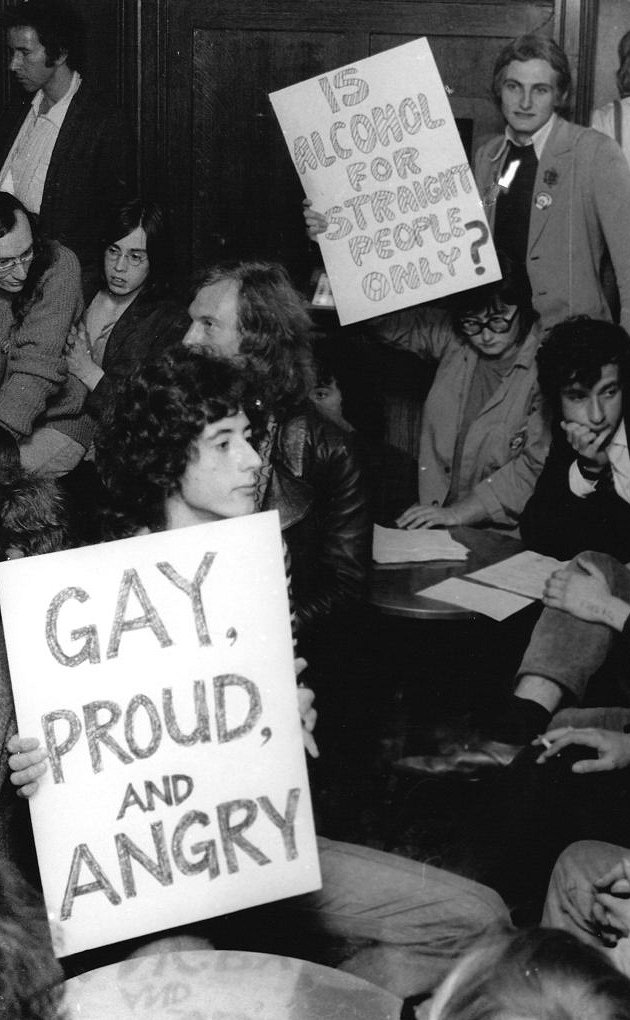
Today 40 years ago, the first Gay Pride rally through the centre of London took place. There had already been Gay Pride gatherings - the first being in Highbury Fields in 1970. Now we had the prominence and visibility of appearing en masse in the heart of the capital! Needless to say, the tireless Peter Tatchell was involved in organising it:
"Not surprisingly, only 700 people joined the first ever Gay Pride march in Britain, held in London on 1 July 1972. Many of my friends were too scared to march. They thought everyone would be arrested. We weren’t arrested, but we were swamped by a very heavy, aggressive police presence. They treated us like criminals.

Despite this intimidation, we were determined to have a fun time and make our point. The march was a carnival-style parade, which went from Trafalgar Square to Hyde Park. There were lots of extravagant costumes and cheeky banners poking fun at homophobes like the morality campaigner Mary Whitehouse.

"We got mixed reactions from the public – some hostility but predominantly curiosity and bewilderment. Most had never knowingly seen a gay person, let alone hundreds of queers marching to demand human rights. “Aren’t you ashamed?”, one man shouted. “No”, we shouted back, as we blew him a kiss.

Unlike nowadays, there was no festival or entertainment in the park after the march - just an impromptu “Gay Day” - a sort of D-I-Y queer picnic. Everyone bought food, booze, dope and music. It was all shared around.

We played camped-up versions of party games like spin-the-bottle and drop-the-hanky. I won one of the games and my prize was a long, deep snog with Thierry, a gorgeous French gay activist who had come over from Paris.

But it was more than good fun. Same-sex kissing in public was, in 1972, illegal. Our party game was a gesture of defiance. The cowardly Metropolitan Police would have arrested us if we were lone gay couples kissing, but they dared not arrest 700 of us."
Listen to the man himself talking about the event on the BBC.


We may have come a long way in forty years, but let us not be complacent about the importance of Gay Pride. We have a lot of freedoms in the UK, it is true. Many others are not so fortunate across the world. And we should never forget that liberty is sometimes ephemeral, and not to be taken for granted.

Gay people in Weimar Germany experienced the least restrictions, the greatest rights in European gay history in the 1920s and early 30s. In common with many queens today who take pride in avoiding Gay Pride, they believed the "battles had been won", that Gay Pride was "irrelevant", that all that mattered was to be beautiful and to have a party - but in a matter of months, what those German queens took for granted was very soon swept away with the rise of the Nazis.

Once more, we embark on the countdown to next Saturday's World Pride in London and, "scaled down" due to crap management or not, among the feathers, foof and faff we will be making a statement, in support of our oppressed peers in countries across the world, and in opposition to those - even in this country, such as the organised religions - who continue to espouse hate against us.

I've been attending Gay Pride since 1985 - and every consecutive year since 1991 - and I will continue to do so. The need for Gay Pride has not gone away.

Pride London

Thursday, 2 February 2012

"I had good legs. Some boys used to wolf-whistle me."


One of our heroes Peter Tatchell celebrated his 60th birthday last week! Heavens... Here is his article in Time Out marking the occasion, reprinted in full:
I've just marked my sixtieth birthday and I'm now celebrating 45 years of human rights campaigning and 10 years of my human rights organisation, the Peter Tatchell Foundation. It seems so unreal, so implausible. After all, nothing in my family background inclined or prepared me for a lifetime of LGBT and human rights activism.

I was born in Melbourne in 1952; growing up in a period of illiberal government and anti-communist witch-hunts. My parents were ultra-conservative evangelical Christians, similar to those depicted by Jeanette Winterson in her book, 'Oranges Are Not The Only Fruit'. On the positive side, they taught me to stand up for what is right and to not follow the crowd - a maxim I still live by.

My father, Gordon, worked in an engineering factory, as a lathe operator. Mardi, my mother, alternated between being a housewife and working in a biscuit factory. She had bouts of chronic, life-threatening asthma. There was no NHS in Australia in those days, so much of our family income went on medical bills. We were dirt poor. This hardship probably honed my passion for justice.

From the age of eight, whenever my mother was ill, I had to run the house and bring up my younger brother and sisters; cooking and washing when I got home from school. It restricted my play time with friends but made me independent and resourceful. Being born a few years after the end of the Second World War, many comics, books and films had war themes.

By the age of 11, I used to ask adults: 'Why did people allow Hitler to get power? Why didn't they stop him?' No one gave me a satisfactory answer. I vowed that if I ever saw tyranny and injustice I would not remain silent and do nothing. In 1963, I saw reports about the racist bombing of a black church in Birmingham, Alabama, which killed four young girls who were about my own age. I was stunned, horrified. It made me a life-long anti-racist. I was inspired by Dr Martin Luther King and the black civil rights movement.

My campaigning for human rights began in 1967, aged 15, when I protested against the hanging of an alleged killer, Ronald Ryan, despite doubtful, conflicting evidence. His execution destroyed my trust and confidence in the police, courts and government; resulting in a lifetime of scepticism towards authority. It opened my eyes to other injustices: the mistreatment of the indigenous Aboriginal people and the brutal war being waged against Vietnam by the US and Australian governments.

At school, I was rebel. I demanded and won the right of pupils to have a say in running the school. On July 4, 1968, we burnt the US flag in protest at the Vietnam War. I was not aware of my gayness.

I had good legs. Some boys used to wolf-whistle me. I was gently teased with jibes of 'poofter Pete'. It didn't upset me, because I was confident that I was straight. Besides, I was popular and well liked.


My fellow pupils voted me school captain in 1968. That year, aged 16, I had to leave school to get a job, to help the family income. My passion was art and design. I wanted to go into architecture but I had no qualifications. So I settled for design and display in a big department store. That's where I first met gay people and soon after realised I was gay.

I fell in love, aged 17. I read a report about gay protests in New York in late 1969 and immediately decided that I wanted to be part of the fight for gay liberation. Drawing lessons from the black civil-rights movement, I concluded that gay people were an oppressed minority just like black people - and that the black tactics of non-violent direct action and civil disobedience could be applied to the struggle for LGBT freedom.

Australia had conscription for Vietnam. I was not willing to fight an unjust war. The penalty for refusal was two years jail. So I skipped the country and came to London in 1971. Within five days I was at my first meeting of the newly formed Gay Liberation Front.

Modelled on the methods of the black civil-rights movement, I helped organise sit-ins at pubs that refused to serve 'queers'. We forced the pub owners to back down. Little did I imagine that 30 years later, in 2011, I'd be standing outside the John Snow pub in 'gay' Soho, protesting against the eviction of a gay couple for kissing. It just goes to show that the price of queer freedom is eternal vigilance.
What a man! And still looking good for his age...

Peter Tatchell Foundation

February is LGBT History Month.

Sunday, 18 September 2011

No religious exemptions!


John-John, Paul and I joined the “Secular Europe Campaign” in its protest march yesterday.


Praise be to the Invisible Stoat of Destiny!

About 1000 of us congregated at the Temple end of the Embankment, with a magnificent array of placards, flags and banners. We joined the Gay and Lesbian Humanist Association (GALHA) and many other like-minded groups to protest against:
  • the privileged status of the churches under Article 17 of the TFEU (Treaty on the Functioning of the European Union)
  • the privileged position of religious organisations in politics and the law
  • the special status of the Vatican in the United Nations
  • state-funded faith schools
  • the economic privilege and political influence of the Vatican

And to promote:
  • freedom of religion, freedom of conscience and freedom of speech
    women’s equality and reproductive rights
  • equal rights for LGBT people in all the European Union
  • a secular Europe – democratic, peaceful, open and just, immune to the clandestine influence of privileged religious (or other) organisations
  • one law for all, no religious exemptions from the law
  • state neutrality in matters of religion and belief


At the conclusion of the march - which was very jolly, and got lots of shouts and waves of approval from passers-by along the route - we had a succession of eminent speakers, including Peter Tatchell, the president of the National Secular Society Terry Sanderson and David Pollock, President of the European Humanist Federation.

Andrew Copson, Chief Executive of the British Humanists Association said:
"We are marching today for a secular Europe. Europe is the continent where secularism was invented, where liberal democracy first flowered, and Europe played a major part in developing the very concept of human rights and we should celebrate that today... What does it mean to live in a free and liberal secular democracy? It means if you don’t like abortion, you don’t have to have one. If you don’t like gay marriage, you don’t have to have one, or be a guest at one. If you don’t like assisted dying for the terminally ill, you don’t have to opt for it. But it also means that you can’t enlist the state to force your choices, preferences, prejudices and dogmas on all your fellow citizens."
Among the shocking revelations from the rally were the personal account of Sue Cox about her own childhood abuse at the hands of a Catholic priest and the church's subsequent cover-up of the facts, the ex-Muslim Maryam Namazie and her forthright views on Sharia law and the burka ("it is not just a piece of clothing - it is a symbol of man's ownership of a woman"), and the Italian campaigner who exposed the €3bn tax exemptions for the Vatican his country gives (and by implication, all EU countries contribute to).

Great stuff, and so important! I am very pleased I was there...


One of the more famous of the people lending their endorsement to the campaign was the award-winning author Philip Pullman:


More about the march and rally (including more pictures from the event)

Another report from the march